

Elements That Built Our World
Tellurium: The Element That Hid Gold in Plain Sight
Meet element 52: the connection between overlooked gold ore, useful alloys and semiconductor technology.
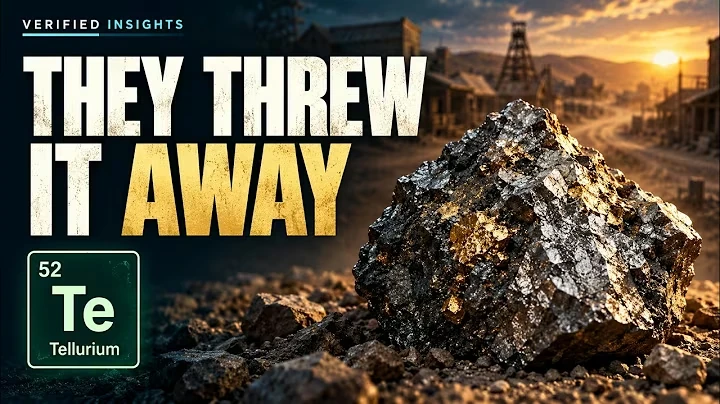
Gold does not always look like gold. In Western Australia’s goldfields, some valuable material was once treated as ordinary waste because the gold was chemically combined with tellurium. The story makes element 52 a useful introduction to the difference between recognising a substance and understanding its chemistry.
- Atomic Number
- 52
- Group / Period
- 16 / 5
- State at 20°C
- Solid
- Element Symbol
- Te
Reference values: Royal Society of Chemistry. The tile is a graphic label, not a photograph of a specimen.
The Gold Hidden in a Compound
Calaverite is a gold telluride, commonly written AuTe2. Its appearance is very different from a familiar yellow nugget. According to the Western Australian Museum, gold-bearing tellurides in Kalgoorlie’s Golden Mile were identified in May 1896, three years after gold was first discovered there. [1]
Before their significance was understood, telluride-bearing rocks were discarded and used on tracks, walkways and in building material. The museum describes calaverite as containing about 42% gold. The lesson is not that every dull rock is valuable; it is that visual familiarity alone can miss an unfamiliar mineral. Identifying a compound requires more than recognising the appearance of one element within it.
What Is Tellurium?
The Royal Society of Chemistry describes tellurium as a semi-metal. Its symbol is Te and its atomic number is 52: a tellurium atom has 52 protons. The element belongs to group 16 of the periodic table. These labels describe the element itself, while names such as calaverite identify particular minerals containing it. [2]
This distinction is useful throughout our Elements series. A pure element, an alloy and a chemical compound are different things. The properties of a useful material are not necessarily the properties you would guess from its ingredients in isolation.
Beyond the Goldfields
Tellurium’s uses include additions to alloys and roles in semiconductor technology. The RSC lists applications in solar cells and materials made with other metals. Industrial usefulness can depend on a small addition changing how a material behaves, rather than on using a large block of the pure element.
That gives the story a wider connection: an element encountered through an old mining mistake can also belong in a discussion of modern technology. The interesting thread is the changing understanding of the material, not a claim that every application uses tellurium in the same form.
How to Explore an Element
For each entry in this series, start with three questions: what is the element, where is it encountered, and what does it do in a useful material? Then check which form is being discussed. A photograph of an ore, a label on a periodic table and a manufactured component may all relate to the same element without being interchangeable examples.
Tellurium is the first published website entry in Elements That Built Our World, matching our existing video. Future entries will be added to the Elements index as they are published; the series does not have to follow atomic-number order.
Watch the Verified Insights Video
Sources and Further Reading
- Western Australian Museum — Calaverite
- Royal Society of Chemistry — Tellurium
- IUPAC — Periodic Table of Elements
Sources checked 13 November 2026. Article by Verified Insights / Strike Labs.