

Elements That Built Our World
Neon: The Gas Behind the Famous Glow
Meet neon, element 10: why it glows orange-red, how gas-discharge signs work, its discovery and uses, and why LED neon signs contain no neon gas.
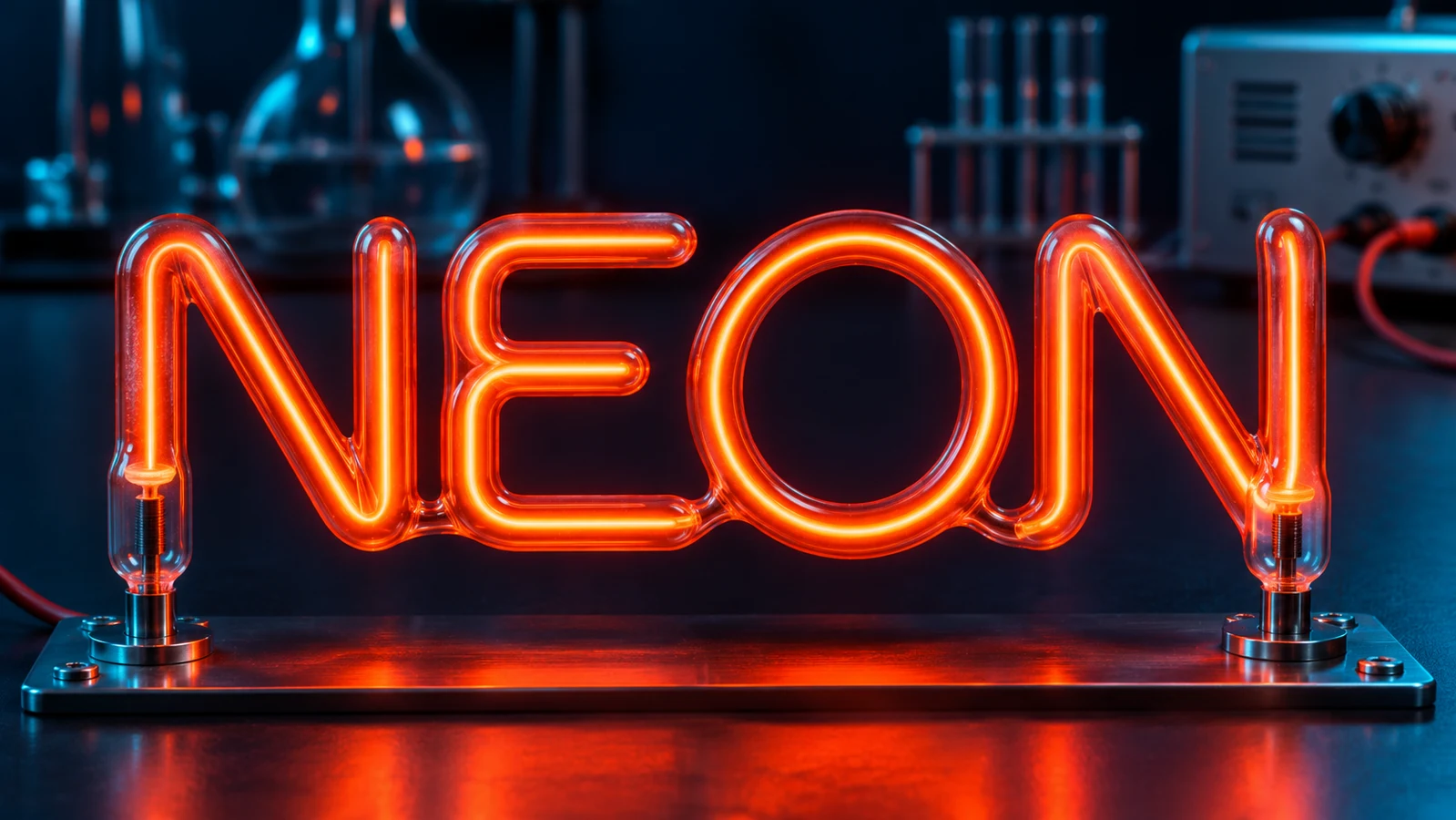
Switch off the current and neon is invisible: a colourless gas sealed inside glass. Apply the right electrical conditions and it becomes a vivid orange-red line of light. That transformation helped turn an obscure atmospheric element into a word associated with nightlife, advertising and colour itself.
Neon at a Glance
| Property | Neon |
|---|---|
| Symbol and atomic number | Ne; 10 |
| Element family | Group 18, the noble gases |
| At room temperature | Colourless gas |
| Characteristic discharge glow | Orange-red |
| Discovery | William Ramsay and Morris Travers, 1898 |
| Normal boiling point | About −246°C |
These reference values describe the element, not a neon sign’s operating temperature. A glowing sign is not a container of boiling liquid neon. The very low boiling point becomes relevant when neon is cooled for specialised cryogenic work.
How Does a Gas Make Light?
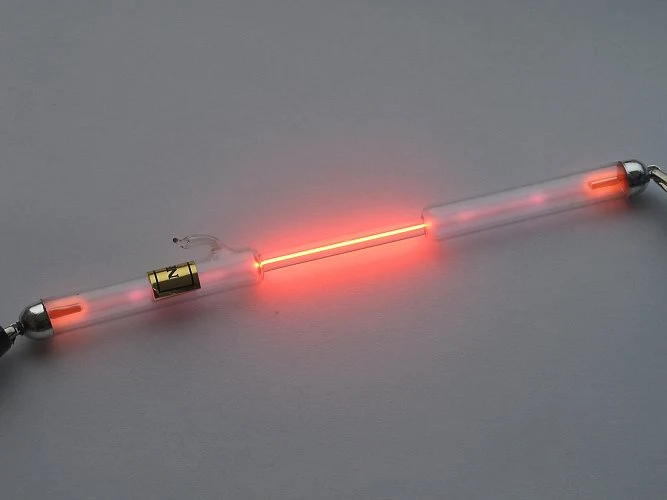
A discharge tube contains gas at low pressure, with electrodes connected to an electrical supply. The electric field accelerates charged particles. Collisions transfer energy to atoms; when excited atoms release energy, they emit light at characteristic wavelengths.
A neon discharge produces many spectral lines rather than one perfectly pure colour. Together, the visible emissions give its familiar orange-red appearance. Scientists can separate the light with a spectroscope and study the pattern. A glowing colour is an invitation to measure, not a substitute for a measured spectrum.
The US National Institute of Standards and Technology maintains reference tables of strong neon spectral lines. Such records connect the shopfront glow to laboratory spectroscopy: the same element has a recognisable pattern of atomic emissions.
Why Every Neon Sign Is Not Made With Neon
“Neon” became a broad name for luminous tubing, but the physical light source matters. Pure neon produces orange-red light. Other traditional sign colours can involve different gases, glass treatments or phosphor coatings. Modern products sold as LED neon use light-emitting diodes inside flexible diffusing material instead of a neon gas discharge.
A blue or green “neon” product therefore does not demonstrate that pure neon naturally glows blue or green under the same conditions. Read the construction description before drawing a chemistry conclusion. The distinction is useful when choosing an illustration, restoring a sign or explaining a demonstration.
Discovery: A New Gas From Air
Ramsay and Travers isolated neon in 1898 during their work on liquefied air and the rare atmospheric gases. Its name comes from the Greek word neos, meaning new. According to the Royal Society of Chemistry, neon represents only about 18 parts per million of Earth’s atmosphere.
It can be recovered through industrial air separation. A gas can be present all around us and still be difficult to obtain in concentrated form. The atmosphere is a mixture; collecting the element requires separating it from far more abundant constituents.
From Scientific Glassware to City Signs
NIST’s history of luminous script signs describes low-pressure gas tubes displayed at the 1904 St Louis World’s Fair. Instrument maker Edward Sperling shaped glass into gas names for work led by physicist Perley Nutting.
The same account distinguishes those demonstrations from Georges Claude’s later commercial neon-lamp development and his public display at the 1910 Paris Motor Show. There is rarely just one moment when a laboratory effect becomes an industry. Discovery, glassworking, reliable equipment and commercial production each contribute.
Beyond the Shopfront
Jefferson Lab lists uses including high-voltage indicators, helium-neon lasers and liquid-neon refrigeration. A helium-neon laser uses a gas mixture; its output is not simply a sign tube made narrower. Its operating arrangement controls how light is generated and amplified.
Neon’s low reactivity is part of its identity as a noble gas. That does not make high-voltage lighting equipment safe to open or repair without training. Enjoy a sealed demonstration or a professionally installed sign; this article is an explanation, not wiring instructions.
The Element and the Image
The hero artwork illustrates the warm colour associated with neon. The real discharge photograph below provides a separate documentary example. Neither image is a calibrated measurement: camera exposure, white balance and your display affect the appearance.
Continue with Helium: The Superfluid Near Absolute Zero to explore another noble gas whose most remarkable behaviour appears far from everyday conditions. Neon’s story begins in the same family of elements, then lights up a very different corner of the world.
Sources and Further Reading
- Royal Society of Chemistry - Neon
- Jefferson Lab - The Element Neon
- NIST - Luminous Script Signs
- NIST - Strong Lines of Neon
Sources checked 14 November 2026. Original educational article by Verified Insights / Strike Labs. Images and historical examples are identified separately.