

Elements That Built Our World
Helium: The Superfluid Near Absolute Zero
Helium becomes liquid near 4.2 K and superfluid below about 2.17 K. Discover what happens at 1.8 K and why helium matters to MRI and CERN.
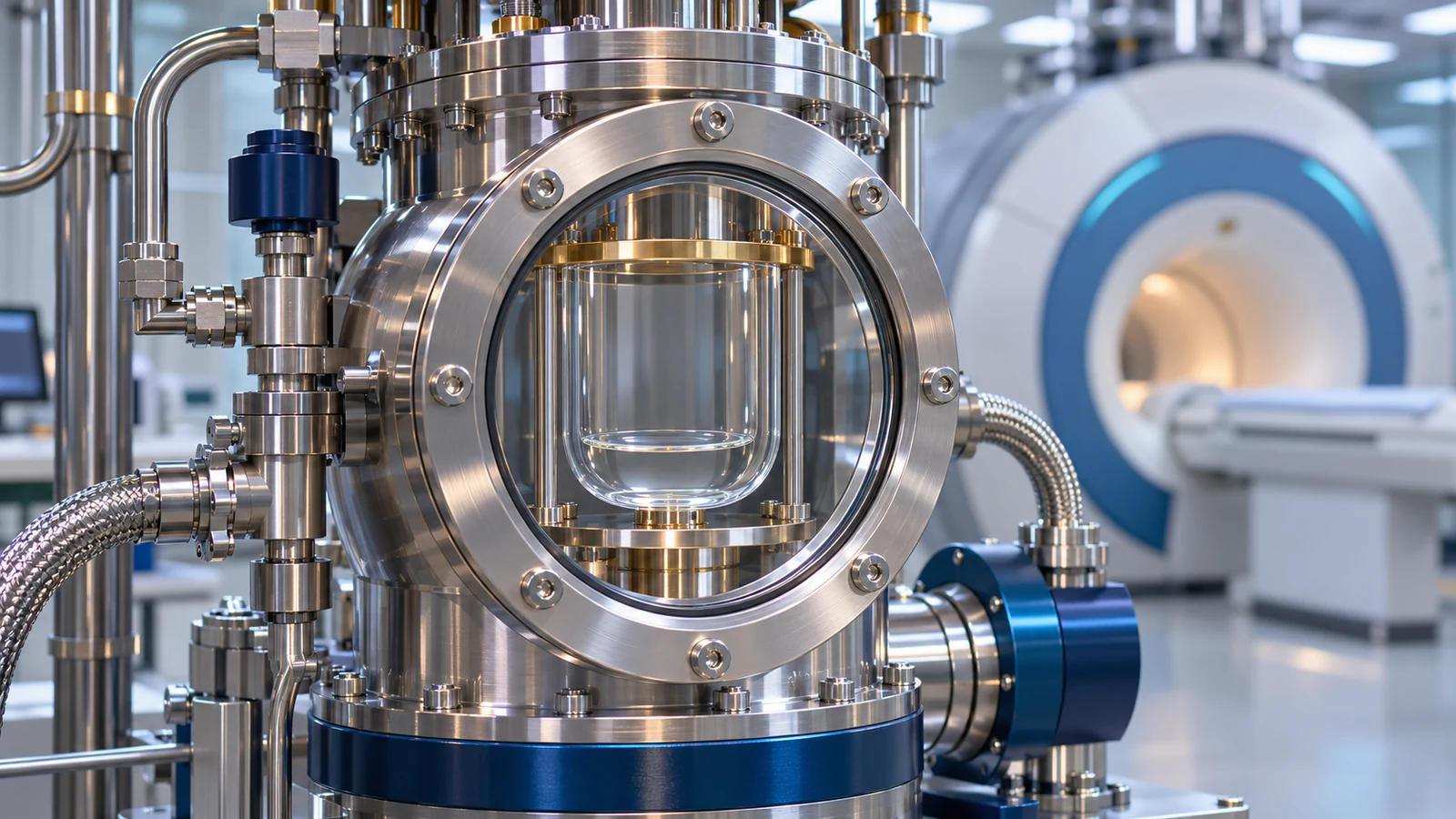
Helium can lift a party balloon, cool a powerful magnet and become a liquid with behaviour that seems to defy everyday experience. Cool helium-4 far enough and it enters a superfluid state: a world of astonishing flow and heat transport, only a little above absolute zero.
- Atomic Number
- 2
- Group / Period
- 18 / 1
- State at 20°C
- Gas
- Element Symbol
- He
Element reference values: Royal Society of Chemistry. The periodic-table tile is a graphic label.
Liquid First. Superfluid Second.
- Helium-4 becomes liquid at about 4.2 K at atmospheric pressure.
- Below about 2.17 K it enters its superfluid phase; the transition depends on pressure.
- At 1.8 K (−271.35°C), helium-4 can already be superfluid. This is not its ordinary gas-to-liquid threshold.
What Does “Above Absolute Zero” Mean?
Absolute zero is 0 kelvin, or −273.15°C. A temperature of 1.8 K therefore means 1.8 degrees above that lower limit, not −1.8°C. Kelvin temperatures use the symbol K without a degree sign. The size of one kelvin equals the size of one Celsius degree; their zero points differ.
| Temperature | Celsius | What It Means |
|---|---|---|
| 4.2 K | −269°C | Gas can condense to liquid at atmospheric pressure. |
| 2.17 K | −270.98°C | Approximate superfluid transition near saturated vapour pressure. |
| 1.8 K | −271.35°C | Below that transition; helium-4 is in the superfluid regime. |
The distinction matters because becoming a liquid and becoming superfluid are separate changes. A demonstration at 1.8 K is showing helium colder than both landmarks, under suitable laboratory conditions.
A Liquid That Took Decades to Reach
In 1908, Heike Kamerlingh Onnes succeeded in producing liquid helium. The achievement made helium both an object of study and a tool for cooling other materials. In 1911, he discovered that mercury’s electrical resistance disappeared at sufficiently low temperature. The Nobel Prize account of his work connects that research with the discovery of superconductivity.
Superconductivity concerns electrical current. Superfluidity concerns fluid flow. Both belong to low-temperature physics, but one term should not be used as a substitute for the other.
What Makes a Superfluid Extraordinary?
Below its transition temperature, liquid helium-4 exhibits behaviour described using a normal component and a superfluid component. The latter can flow without viscosity under appropriate conditions. These are components of a description of one liquid, rather than two separate liquids poured into a container. The 1978 Nobel Physics background discusses the experimental discoveries and Landau’s explanation.
One striking demonstration uses a thin film that travels along the container’s surfaces, over its rim and down the outside. Another lets helium flow through extraordinarily fine passages. Nobel laureate David Lee describes these effects in his Nobel lecture. The liquid is following a physical path along a film or through openings; it is not simply passing through every solid object.
The Veritasium Demonstration
For a visual companion, Veritasium’s helium video on YouTube explores liquefaction, superfluidity and the fountain effect. Its chapter list places “Zero Viscosity and Superfluidity” at 28:41. This is an independent creator’s video, not a Verified Insights production. Our article is an original explanation with separately linked scientific references.
Why It Matters Outside the Laboratory
CERN uses helium to keep the Large Hadron Collider’s main superconducting magnets at about 1.9 K. Its cryogenics guide explains that superfluid helium transports heat exceptionally well, helping stabilise a vast cooling system. A strange laboratory property becomes a practical engineering advantage.
The Royal Society of Chemistry also identifies helium’s use in cooling MRI and NMR magnets, leak detection and protective atmospheres for manufacturing. Helium is colourless and chemically unreactive. Its scientific importance comes from its properties, not from the colour of an illustration.
A balloon makes helium familiar. A cryostat reveals how unfamiliar the same element can become. The exciting part is not that physics stops working near absolute zero—it is that experiments make a different part of physics visible.
Sources and Further Reading
- Royal Society of Chemistry — Helium
- CERN — Cryogenics: Low Temperatures, High Performance
- Nobel Prize — Heike Kamerlingh Onnes, Facts
- Nobel Prize — Physics 1978, Scientific Background
- David M. Lee — Nobel Lecture (PDF)
- Veritasium — Independent Helium Demonstration on YouTube
References checked 13 November 2026. Original article by Verified Insights / Strike Labs. Historical reference examples are identified in the text.