

Aviation and Engineering
Black Boxes: Recovering a Plane’s Final Moments
How aircraft black boxes preserve cockpit audio and flight data, how underwater searches work, and how investigators turn recordings into evidence.
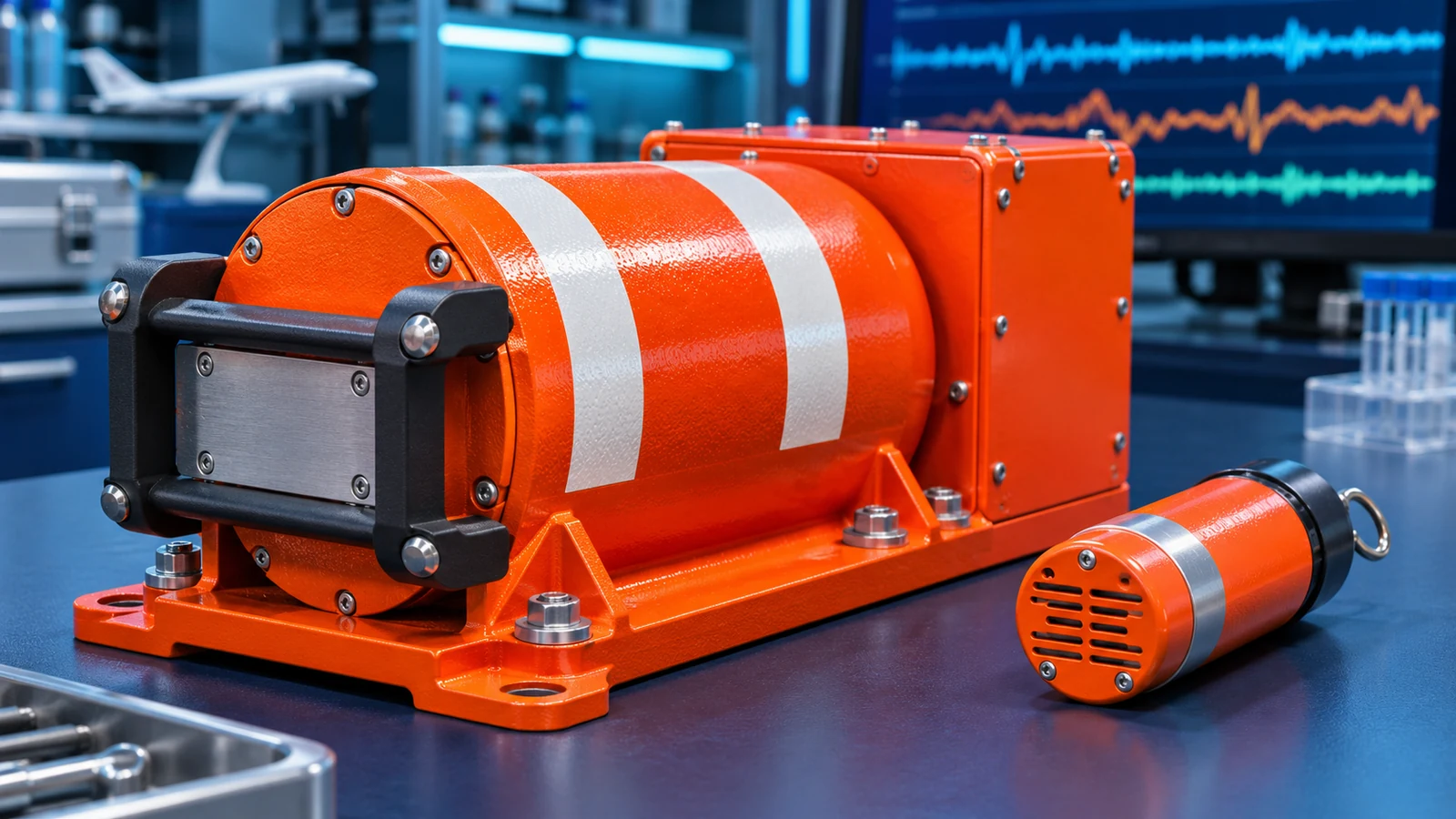
A wrecked aircraft may leave thousands of fragments and no one able to explain its final moments. Yet a small orange recorder can preserve a different kind of wreckage: a sequence of sounds, movements and measurements. The challenge is turning those fragments of information into an explanation that survives scrutiny.
At a Glance
- A cockpit voice recorder captures sound; a flight data recorder captures measurements.
- The familiar “black boxes” are normally orange to make them easier to find.
- A recorder is evidence to interpret alongside the aircraft, weather and other records.
Two Records of the Same Flight
The cockpit voice recorder, or CVR, records the cockpit’s sound environment. That can include conversations and radio calls, but also warning tones and changes in background noise. The flight data recorder, or FDR, stores parameters describing the aircraft’s operation. Modern aircraft can record thousands of parameters, far beyond a simple track of speed and altitude. The Australian Transport Safety Bureau explains the different roles in its flight-recorder fact sheet.
Think of them as two witnesses with different abilities. A warning tone may establish what the crew could hear, while a data trace shows what a sensor reported. Neither automatically explains what a person understood or why a system behaved as it did. Their value grows when the records can be compared.
Why the Orange Box Has an Australian Story
In the 1950s, Australian scientist David Warren developed a recorder that could preserve cockpit speech as well as instrument information. He worked at the Aeronautical Research Laboratories in Melbourne. Australia’s Defence Science and Technology Group describes the connection between his interest in recording technology and the invention’s development in its biography of Warren.
The National Museum of Australia’s account places that work in the context of early jet-airliner accidents and the difficulty of reconstructing them. The powerful idea was to preserve information from inside the flight, rather than rely entirely on whatever could be recovered outside it.
Built to Protect the Memory
The important part is the protected recording medium. The ATSB describes solid-state memory and demanding tests involving impact, crushing and fire. That protection improves the chance of recovery; it cannot make every accident survivable for the equipment. Recorders are commonly installed towards the tail, an area that has often experienced less severe accident damage.
“Black box” is therefore a nickname rather than a colour description. Orange paint helps searchers recognise a recorder among debris. It does not mean the whole aircraft’s electronics are contained in that one unit.
Finding One Beneath the Ocean
Many crash-protected recorders carry a water-activated acoustic locator beacon. It emits sound to help underwater search teams locate the equipment. It is not a GPS transmitter continuously broadcasting the aircraft’s position to a satellite. Detection depends on search equipment reaching the right area and on conditions such as noise, depth and whether debris obscures the beacon.
This is where aviation meets deep-ocean exploration: finding a small object and recovering it are separate engineering problems. A promising acoustic contact still has to become an identified object that a recovery system can reach.
From Download to Reconstruction
The ATSB’s technical-investigation overview describes its capacity to download and analyse recorder information. Its specialist work also covers structural, mechanical and operational factors. A successful readout can substantially shorten an investigation, but the wider evidence remains essential.
For a reader, the useful distinction is between a recorded measurement and a conclusion. A change in altitude is an observation. Explaining that change requires an account consistent with the aircraft’s systems and the other evidence. A dramatic animation can illustrate that account, but an animation is not an additional independent recording.
Why There Is No Universal Recording Time
Recording capacity depends on equipment and applicable standards. The Transportation Safety Board of Canada’s backgrounder describes separate voice and flight-data systems, as well as combined units. Its published examples include 25-hour flight-data and two-hour cockpit-audio recordings. Those examples should not be treated as a claim about every aircraft flying today.
The greatest achievement of a flight recorder is not providing an instant answer. It is preserving enough information for investigators to ask better questions—and potentially prevent the same sequence happening again.
Sources and Further Reading
- ATSB — Black Box Flight Recorders
- Defence Science and Technology — Dave Warren
- National Museum of Australia — Black Box Flight Recorder Invented
- ATSB — Investigating Complex Factors
- Transportation Safety Board of Canada — Flight Recorders (2020 Backgrounder)
References checked 13 November 2026. Original article by Verified Insights / Strike Labs. Historical reference examples are identified in the text.